
An Argument for Giving to People in Extreme Poverty
Before diving into this one, we want to say that it’s your money, and you should give it wherever you want.
#1: Your dollar goes further
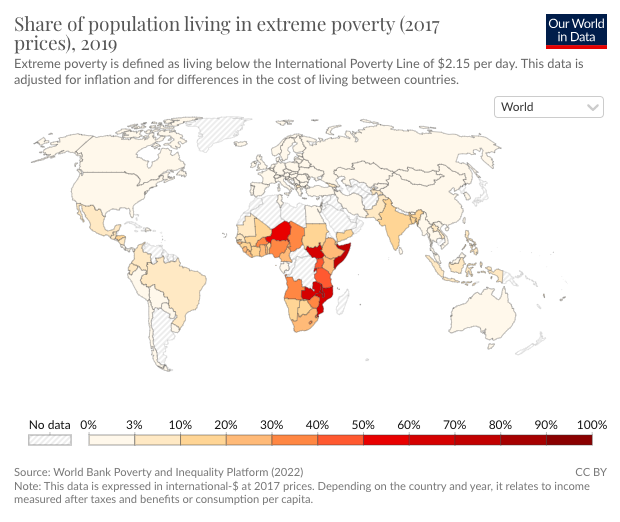
Because the people you’re helping live on less than $2.15/day, a small amount of money can make a massive difference. $40 is a month’s income for someone living in extreme poverty.
Furthermore, it costs little to protect people in extreme poverty from the leading causes of death and suffering. Preventable diseases like malaria and vitamin A deficiency account for 83% of under-5 deaths globally. It costs just $5 – $7 to protect one person from malaria for a year and $2 to save one child from going blind and potentially dying from vitamin A deficiency.
Giving opportunities like this don’t exist in the U.S. because we’ve eradicated diseases like malaria, fortified our foods with vitamins, offered safety net programs like SNAP (food stamps) and Medicaid, and have some of the best healthcare in the world.
#2: You can do both – give internationally and give locally
A little can do a lot when giving to people in extreme poverty. A one-time donation of $20 would accomplish one of the following items.
- Provide four long-lasting insecticide-treated bed nets, protecting eight people from malaria for several years.
- Provide ten children with vitamin A supplements for an entire year, which protects them from the leading cause of childhood blindness.
- Provide ½ a month’s income to a person living in extreme poverty.
#3: You won the lottery, this is an opportunity to help people who didn’t
If you were born in the U.S., you are lucky. You are among a mere 4% of the global population. You had twice the chance of being born into extreme poverty. While being born in the U.S. doesn’t guarantee a great life, it does help. Compared to low-income countries, there’s a surplus of wealth, healthcare, opportunity, and education. If you were born in one of the 49 countries in sub-Saharan Africa, you’d have a 14X higher chance of dying before age five.
#4: Now, more than ever, we can see and trust the impact of our donation.
Thanks to the rise of GiveWell and The MIT Poverty Action Lab, independent researchers are evaluating the effectiveness of the world’s most promising health and poverty-alleviation programs. They search for charities that save and improve lives the most per dollar. Their recommendations utilize data from randomized controlled trials, in-depth research on the charity’s past and forecasted spending, funding needs, site visits, and interviews with its staff. We use GiveWell’s reports to inform our list of recommended charities, and each of our charities has received a top ranking from GiveWell. While Charity Navigator has over 200,000 charities listed, GiveWell has just four. This reflects GiveWell’s focus on only the most promising programs and the depth of their evaluations.
#5: Not enough money goes to helping people in extreme poverty
Only 7% of U.S. donation dollars go to international causes. That means that ~93% of U.S. donation dollars stay within the U.S., one of the wealthiest countries in the world.
The average American thinks the U.S. government spends 25% – 30% of its budget on foreign aid; the actual amount is less than 1%.
Here’s a great video of Bill Nye dispelling myths about poverty.
—
Thank you as always for reading.
If you want to make a donation to help people living in extreme poverty you can start giving $10/month through Pepper, donate to one of GiveWell’s featured charities, or donate to one of The Life You Can Save’s featured charities. Each organization features evidence-based charities that can save and improve lives the most per dollar.
Cheers,
Team Pepper